

- Home
- North Island
- South Island
- NZ Travel Guide
- Contact Us
New Zealand Hidden Gems
Published: 2nd October 2026
10 Places Most Travellers Miss
Most visitors to New Zealand follow a familiar trail. They tick off Milford Sound, Queenstown and Hobbiton before heading home believing they’ve seen the country’s highlights. But beyond the well-worn tourist route lies another New Zealand – one of forgotten gold towns, remote wilderness lodges, abandoned whaling stations and adventures few overseas visitors ever hear about.
You might find yourself jet boating down the wild Wairaurahiri River into the untouched landscapes of southern Fiordland, staying at the remote Waitutu Lodge deep in the South Island wilderness, travelling through abandoned railway tunnels aboard a self-driven rail cart in the King Country, or walking to a secluded Northland harbour where the remnants of an old whaling station slowly return to nature.
These are not necessarily New Zealand’s most famous attractions. Some aren’t even well known to Kiwis themselves. They are the remarkable places and experiences often missed, yet deserving of far more attention. If you’re prepared to take the detour, you’ll discover a side of New Zealand that guidebooks rarely reveal.
Where Will These Hidden Gems Take You?
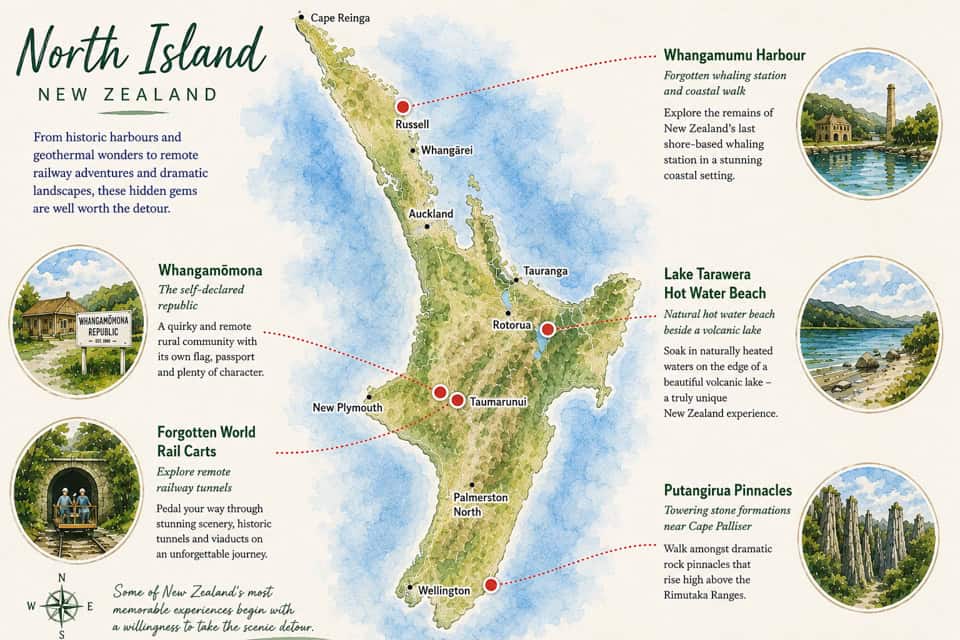
Looking for New Zealand hidden gems away from the usual tourist trail? These remarkable places and experiences showcase a different side of Aotearoa, from remote wilderness adventures and forgotten settlements to hidden geothermal beaches and spectacular natural wonders.
From Northland’s forgotten harbours to Southland’s remote wilderness, these remarkable places are scattered across New Zealand for travellers willing to venture beyond the usual tourist trail.
North Island
- Whangamumu Harbour – Northland
- Putangirua Pinnacles – Wairarapa
- Lake Tarawera Hot Water Beach – Rotorua
- Whangamōmona – Taranaki
- Forgotten World Rail Carts – King Country
South Island
- Ōpārara Basin – West Coast
- Clay Cliffs – Ōmarama
- Ross – West Coast
- Ōkārito – West Coast
- Wairaurahiri River & Waitutu Lodge – Southland
North Island Secrets Worth Discovering
Whangamumu Harbour – Northland's Forgotten Whaling Station
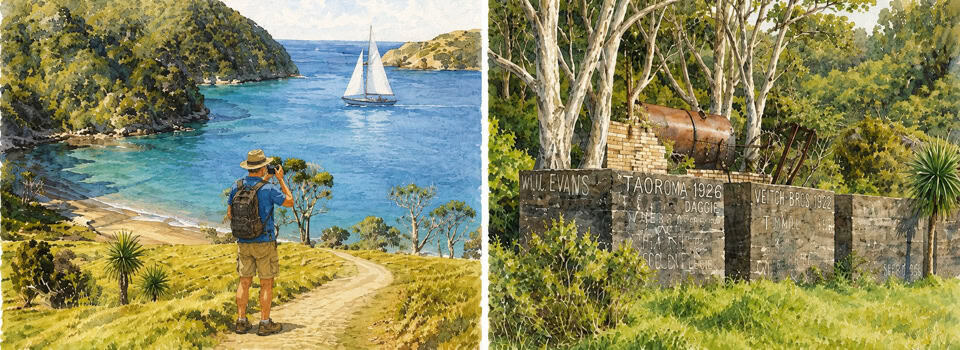
Hidden along the Tutukaka Coast, Whangamumu Harbour is one of Northland’s most atmospheric walks and a place where history quietly blends back into nature. Today, visitors arrive at a peaceful, sheltered harbour fringed by native bush, often surprised to learn they are standing among the remains of Northland’s last factory-based whaling station.
What makes Whangamumu even more remarkable is that it was once home to the only whaling station in the world known to catch whales using nets. Established in the 1890s and operating until the early 1940s, it became Northland’s longest-running and most successful whaling station. In its heyday, a catch of 16 to 20 whales a season was considered successful, with each whale worth around £100.
A one-hour walk through farmland and regenerating forest leads to the secluded harbour, where history still lingers among the trees. Look closely and you’ll discover the slipway that once hauled whales ashore, the old boiler, and the large vats that held whale oil before shipment overseas. These weathered remains tell the story of an industry that helped shape Northland’s coastal communities before fading into history.
The station finally closed after a combination of declining whale numbers, economic hardship and changing times. Local accounts even suggest that after the sinking of the Niagara in 1940 released oil into nearby waters, humpback whales altered their migration route and never returned to Whangamumu in the numbers they once had.
Today, Whangamumu Harbour is valued for very different reasons. It is one of Northland’s most picturesque anchorages, a peaceful place to swim, picnic and reflect on the changing relationship between people and the natural world. If you’re prepared to take the detour, you’ll discover one of New Zealand’s most remarkable hidden stories.
Why It’s One of New Zealand’s Best-Kept Secrets
- The only known whaling station in the world to catch whales using nets.
- Northland’s longest-running and most successful whaling station.
- Historic relics remain hidden among regenerating native bush.
- A spectacular coastal walk with harbour views.
- Rarely crowded, even during summer.
- Combines natural beauty with one of New Zealand’s most unusual maritime stories.
George’s Tip
Bring your swimsuit and allow extra time at the harbour. Many visitors rush back to the car after exploring the historic remains, but the real magic of Whangamumu is simply sitting beside the water, imagining how dramatically this peaceful harbour has changed over the past century.
Getting There
Access to the Whangamumu Track is from Rawhiti Road, approximately 1.1 km beyond the intersection of Manawaora Road and Rawhiti Road.
From Russell, follow Russell–Whakapara Road for 13.8 km before turning onto Kempthorne Road. Continue through Parekura Bay onto Manawaora Road. At the top of the hill, turn left onto Rawhiti Road, where the track entrance is signposted.
Whangamumu can also be reached by private boat, with the harbour providing one of Northland’s most sheltered anchorages.
Putangirua Pinnacles – Wairarapa's Extraordinary Stone Labyrinth
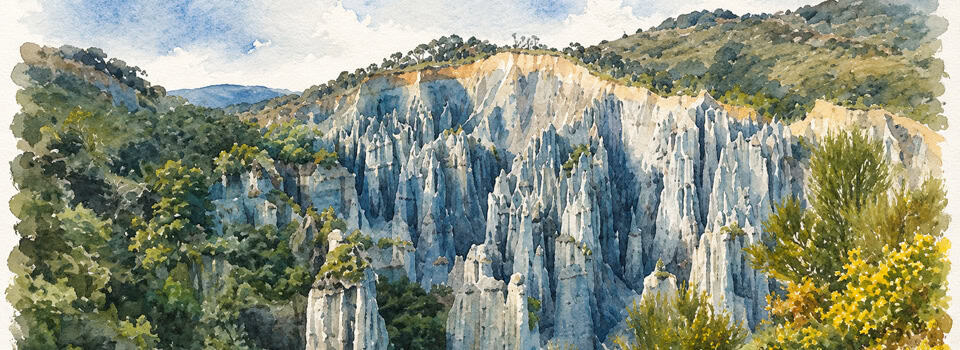
Rising dramatically from an isolated valley near Cape Palliser, the Putangirua Pinnacles are one of New Zealand’s most extraordinary natural landscapes. Towering earth pillars and narrow rock corridors create an almost otherworldly setting that feels more like the backdrop to a fantasy film than a destination hidden at the southern tip of the North Island.
Formed over hundreds of thousands of years, the pinnacles were sculpted by relentless erosion as wind and water carved through ancient gravel deposits left behind by powerful geological forces. The result is a maze of towering rock spires unlike anything else in New Zealand.
Many visitors first became aware of the Putangirua Pinnacles after scenes from The Lord of the Rings: The Return of the King were filmed here, with the eerie formations providing the setting for the Paths of the Dead. Yet despite their cinematic fame, relatively few travellers venture beyond Martinborough and the Wairarapa coastline to experience them firsthand.
The walk itself is part of the adventure. The stream-bed track winds through the heart of the pinnacles, allowing visitors to stand beneath the towering formations and appreciate their sheer scale. For a different perspective, the return journey can be completed via the ridge track, where sweeping views stretch across the valley towards the rugged South Wairarapa coast.
The Putangirua Pinnacles are a reminder that some of New Zealand’s most remarkable places lie just beyond the familiar tourist route. Those willing to make the detour are rewarded with one of the country’s most unforgettable landscapes.
Why It’s One of New Zealand’s Best-Kept Secrets
- Extraordinary rock formations found nowhere else in New Zealand.
- Featured in The Lord of the Rings: The Return of the King.
- Surprisingly uncrowded despite their cinematic fame.
- Choice of stream-bed and ridge walking tracks.
- Spectacular scenery combining geology and coastal wilderness.
- Easily paired with a visit to Cape Palliser Lighthouse.
George’s Tip
Allow time to continue on to Cape Palliser after your walk. The windswept coastline, fur seal colony and iconic lighthouse make this one of the North Island’s most memorable day trips. If possible, visit early or late in the day when the changing light adds even more drama to the pinnacles.
Getting There
The Putangirua Pinnacles Scenic Reserve is located near Cape Palliser at the southern end of the North Island. From Martinborough, allow approximately 1 hour and 15 minutes via Lake Ferry Road and Cape Palliser Road. The car park is signposted from Cape Palliser Road and provides direct access to both walking tracks.
📍 GPS Coordinates: 41.4376° S, 175.2240° E
Lake Tarawera Hot Water Beach – Rotorua's Hidden Lakeside Hot Pools
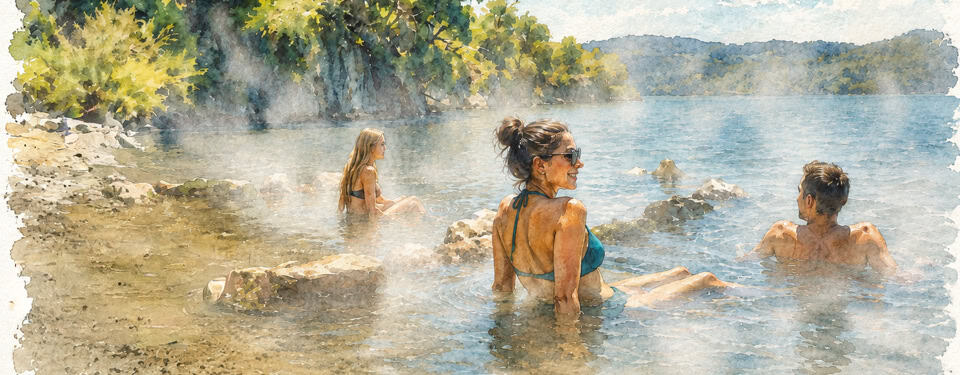
While thousands of visitors soak in Rotorua’s commercial spas each year, those willing to venture a little further can enjoy one of the region’s most memorable geothermal experiences. Hidden on the shores of Lake Tarawera, natural hot water bubbles through the sand, allowing visitors to create their own lakeside spa while overlooking one of New Zealand’s most beautiful volcanic lakes.
Accessible by water taxi or via the scenic Tarawera Trail, Hot Water Beach feels worlds away from the busy geothermal parks of Rotorua. Here, steaming water rises beneath the lakeshore, inviting visitors to dig their own natural pools and alternate between the warm sand and the cool waters of Lake Tarawera. It’s a simple pleasure, but one that many travellers remember as one of the highlights of their New Zealand journey.
The experience is made even more remarkable by its setting. Lake Tarawera lies in the shadow of Mount Tarawera, whose devastating 1886 eruption reshaped the surrounding landscape and buried the famous Pink and White Terraces. Today the lake offers a peaceful reminder of the region’s extraordinary volcanic past.
Why It’s One of New Zealand’s Best-Kept Secrets
- Create your own natural hot pool beside the lake.
- Accessed by boat or a scenic hike.
- Stunning views across Lake Tarawera.
- Far quieter than Rotorua’s commercial spas.
- Combines geothermal activity with wilderness.
- Closely linked to the region’s volcanic history.
George’s Tip
The best experience is arriving by water taxi with a small spade and staying long enough to watch the changing light across the lake. Alternate between the hot sand pools and the cool freshwater for the ultimate natural spa experience.
Getting There
Hot Water Beach lies on the shores of Lake Tarawera, approximately 20 km from Rotorua. Most visitors access it by water taxi from the Tarawera Landing, while more adventurous travellers can reach it via the Tarawera Trail, allowing around 4–5 hours return
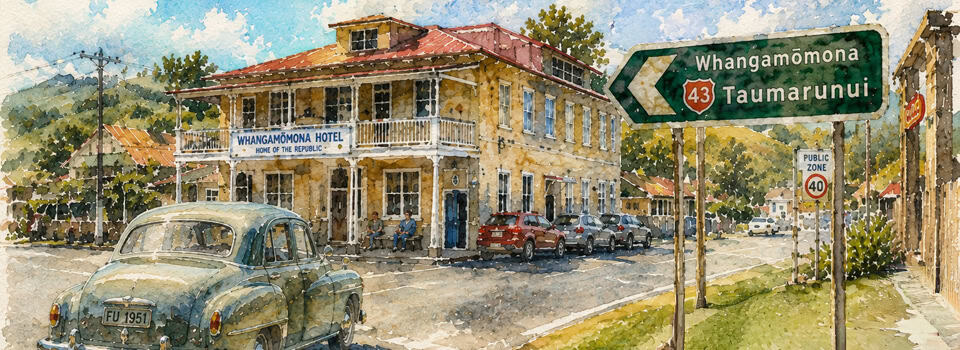
Whangamōmona – The Republic That Refused to Disappear
Tucked away on the Forgotten World Highway, Whangamōmona is unlike anywhere else in New Zealand. With a population of fewer than 100 people, this tiny settlement declared itself an independent republic in 1989 in protest over regional boundary changes. More than three decades later, visitors can still have their passports stamped, meet the locals at the historic hotel and discover a place where Kiwi humour and rural resilience go hand in hand.
The Story
Once a thriving farming community, Whangamōmona’s fortunes changed as families moved away and services disappeared. Rather than fade quietly into history, the township reinvented itself as the self-proclaimed Republic of Whangamōmona. Presidential elections have featured colourful candidates over the years, including a goat, a poodle and a turtle, cementing the settlement’s reputation as one of New Zealand’s quirkiest destinations.
Today, the Republic remains one of the highlights of the Forgotten World Highway. The historic hotel, country atmosphere and tongue-in-cheek independence make it a memorable detour through the heart of rural Taranaki.
Why It’s One of New Zealand’s Best-Kept Secrets
- New Zealand’s only self-declared republic.
- Passport stamps available at the hotel.
- A fascinating slice of rural Kiwi life.
- Located on the spectacular Forgotten World Highway.
- Presidential elections unlike anywhere else.
- Most overseas visitors have never heard of it.
George’s Tip
Stop for lunch at the Whangamōmona Hotel and don’t forget to get your passport stamped. It’s one of those wonderfully quirky experiences that travellers talk about long after they return home.
Getting There
Whangamōmona is located on the Forgotten World Highway (SH43), approximately 65 km east of Stratford and 55 km west of Taumarunui.
📍 GPS Coordinates: 39.1440° S, 174.8990° E
Whangamōmona is one of several highlights found along the spectacular Forgotten World Highway.
Forgotten World Rail Carts – Exploring New Zealand's Lost Railway
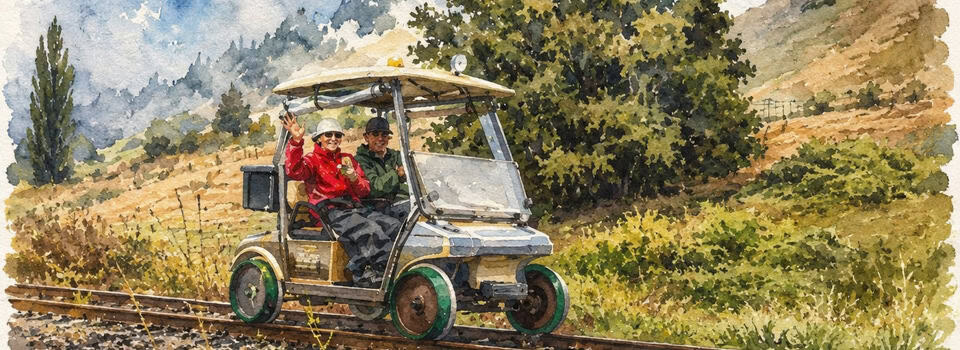
Deep in the King Country, travellers can climb aboard a self-driven rail cart and journey through abandoned tunnels, remote farmland and landscapes inaccessible by road. Forgotten World Adventures has transformed a disused railway line into one of New Zealand’s most unusual experiences, allowing visitors to explore a part of the country few people ever see.
The Experience
Travelling along the historic Stratford–Ōkahukura railway line, the rail carts pass through hand-cut tunnels, cross towering bridges and reveal a side of rural New Zealand that time almost forgot. It’s part adventure, part history lesson and part scenic journey, all wrapped into an experience unlike anything else in the country.
Originally built to connect isolated communities, the railway played an important role in opening up the region before changing transport patterns left sections abandoned. Today, these forgotten tracks have found a new purpose, offering visitors a rare opportunity to experience New Zealand’s railway heritage firsthand.
Why It’s One of New Zealand’s Best-Kept Secrets
- One of the most unique experiences in New Zealand.
- Travel along abandoned railway lines.
- Explore remote areas inaccessible by road.
- Journey through historic tunnels and across viaducts.
- Combines history, scenery and adventure.
- Frequently cited as a highlight by those who experience it.
George’s Tip
If time allows, combine a rail cart journey with a visit to Whangamōmona. Together, they provide one of the North Island’s most memorable off-the-beaten-track adventures.
Getting There
Forgotten World Adventures operates from Taumarunui and Whangamōmona. Advance bookings are essential.
📍 GPS Coordinates: 38.8780° S, 175.2610° E
Remarkable South Island Places Worth the Detour
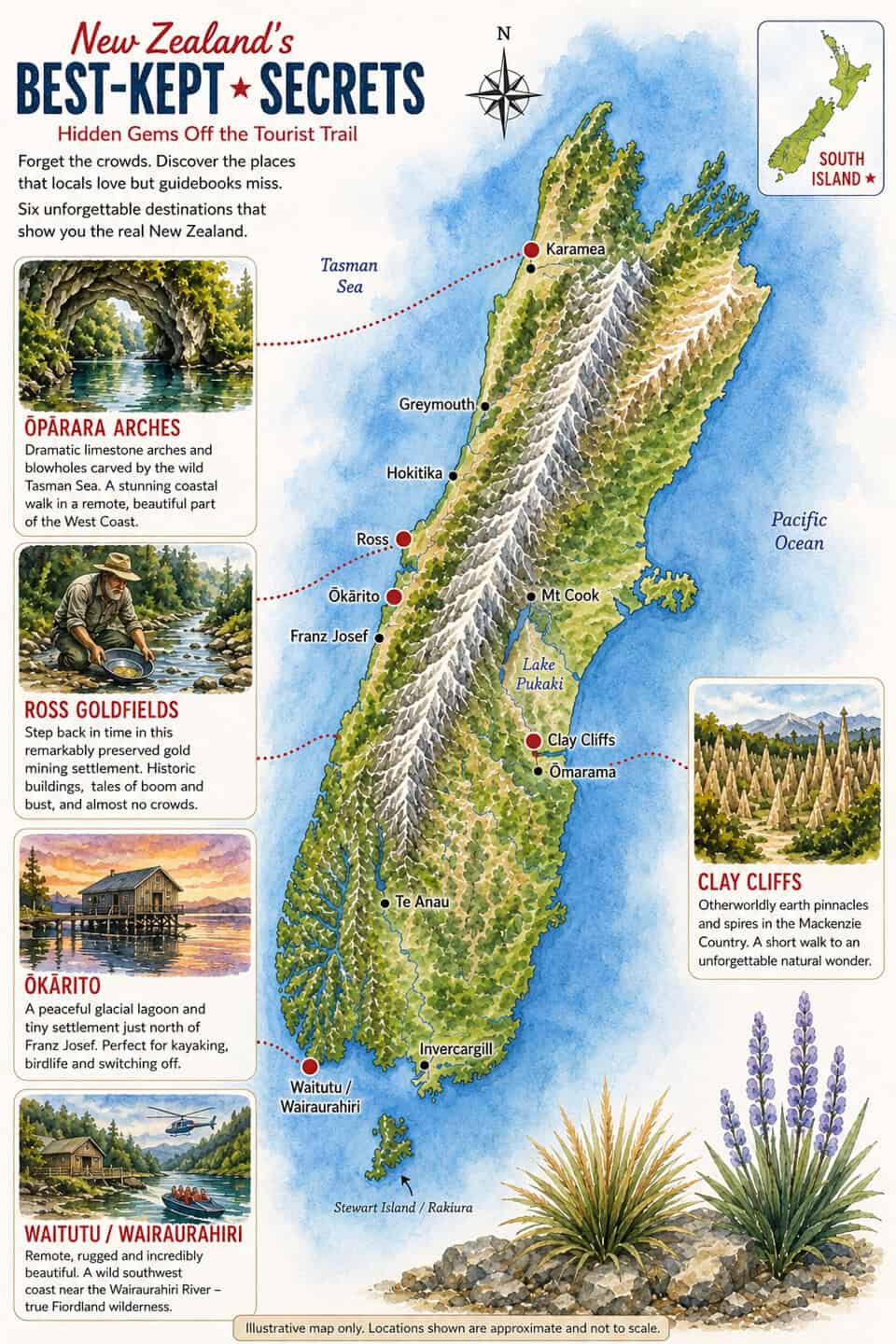
While many travellers follow the familiar route between Christchurch, Queenstown and Milford Sound, some of the South Island’s most memorable experiences lie beyond the main tourist trail. Hidden among ancient rainforests, rugged coastlines, remote wilderness and historic settlements are places that reveal a very different side of New Zealand.
Whether you’re exploring a forgotten gold rush town, jet boating into one of the country’s most isolated lodges, kayaking a peaceful lagoon or standing beneath giant limestone arches, these are the South Island experiences that prove the best discoveries are often found off the beaten path.
Ōpārara Basin Arches – Ancient Rainforest and Hidden Limestone Caves
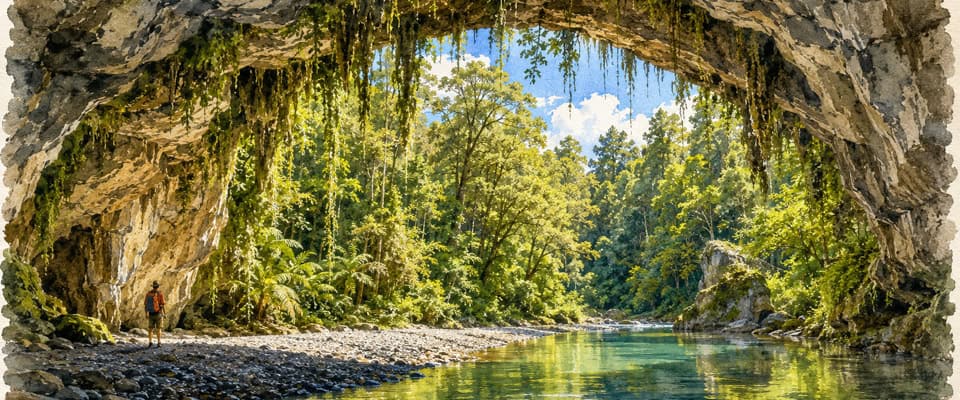
Hidden deep within the rainforests of Kahurangi National Park, north of Karamea on the West Coast, the Ōpārara Basin feels like a forgotten world. Reached via a winding gravel road through dense native forest, this remote landscape is home to some of New Zealand’s most remarkable natural formations – giant limestone arches carved over millions of years by the dark waters of the Ōpārara River.
While many visitors arrive expecting a short stop, the basin is best enjoyed as part of a full day exploring the Karamea region. Between the towering Moria Gate Arch, the tranquil Mirror Tarn, rainforest walks and the journey through one of the South Island’s most remote corners, it’s easy to spend hours discovering this extraordinary landscape. Many travellers choose to stay overnight in Karamea, enjoying the relaxed atmosphere, local accommodation and a meal at the village pub before continuing their journey.
Why It’s One of New Zealand’s Best-Kept Secrets
- Home to some of New Zealand’s largest limestone caves & arches.
- Hidden within the remote rainforests of Kahurangi National Park.
- Moria Gate Arch is over 40 metres high.
- Rarely crowded, even during summer.
- Walking tracks suitable for most visitors.
- Feels like stepping into a prehistoric landscape.
George’s Tip
Don’t rush Ōpārara. The drive from Westport to Karamea is one of the South Island’s great hidden journeys, and the basin itself deserves several hours of exploration. If your itinerary allows, stay overnight in Karamea. You’ll enjoy a more relaxed visit, have time to explore all the main walks and experience one of the West Coast’s most welcoming little communities.
Getting There
Ōpārara Basin is located near Karamea on the northern West Coast, approximately 20 km north of Karamea and around 100 km north of Westport. Access is via a narrow gravel road through Kahurangi National Park, followed by short walking tracks to the arches and viewpoints.
📍 GPS Coordinates: 41.230° S, 172.112° E
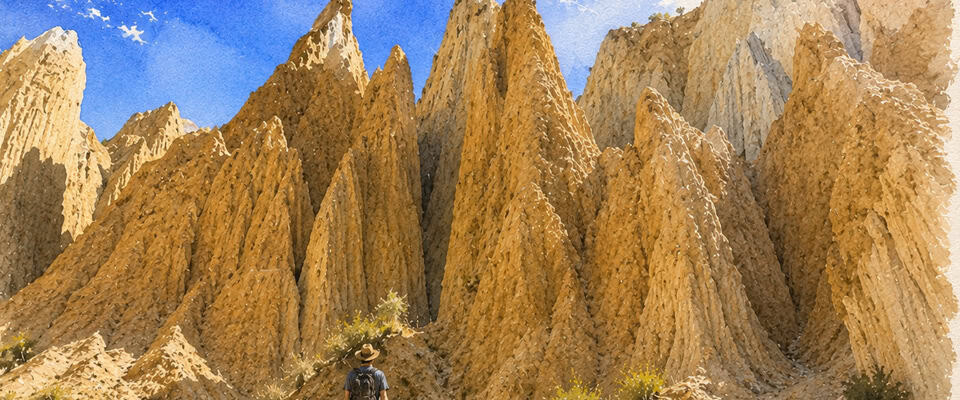
Clay Cliffs – Ōmarama's Hidden Earth Cathedrals
Hidden behind the rolling farmland of the Mackenzie Country, the Clay Cliffs rise unexpectedly from the landscape like a forgotten city carved from stone. Towering pinnacles, narrow gullies and dramatic ridgelines create one of the South Island’s most extraordinary natural wonders, yet many travellers speed past Ōmarama without ever knowing they exist.
The Story
Formed over millions of years through the relentless forces of erosion, the Clay Cliffs were shaped by ancient glaciers that once dominated the region. Wind and rain have gradually sculpted the soft gravel and silt into an intricate maze of spires and canyons, creating a landscape that feels almost surreal.
Unlike some of New Zealand’s more famous attractions, the Clay Cliffs retain a wonderfully low-key atmosphere. A short walk from the car park allows visitors to wander among the towering formations, appreciating both their scale and the silence of the surrounding high-country landscape.
Whether bathed in the warm glow of morning light or casting long shadows late in the day, the Clay Cliffs reward those willing to venture off the main highway with one of the South Island’s most memorable detours.
Why It’s One of New Zealand’s Best-Kept Secrets
- Extraordinary geological formations hidden in the Mackenzie Country.
- Often overlooked by travellers heading between major destinations.
- Short, easy walk suitable for most visitors.
- Incredible photographic opportunities.
- Dramatic changing light throughout the day.
- Feels like stepping into another world.
George’s Tip
Visit early in the morning or later in the afternoon when the soft light brings out the textures and colours of the cliffs. It’s worth lingering a little longer than most visitors do—walk deeper into the gullies and you’ll often find yourself completely alone among these remarkable formations.
Getting There
The Clay Cliffs are located approximately 10 km west of Ōmarama via Quailburn Road. The final section follows a gravel road through private farmland, where a small honesty-box entrance fee applies. Allow around 45 minutes to an hour to explore the formations on foot.
📍 GPS Coordinates: 44.487° S, 169.933° E
Ross – The Gold Rush Town Time Forgot
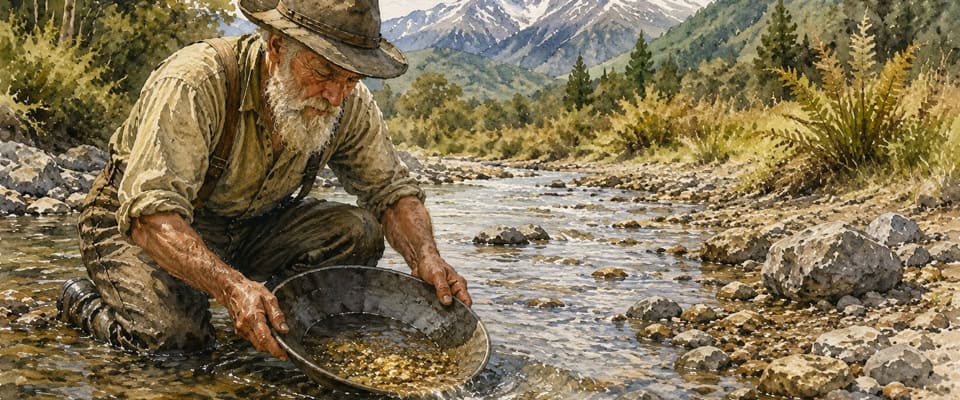
Tucked between Hokitika and Franz Josef, Ross is one of the West Coast’s most overlooked historic towns. During the height of New Zealand’s gold rush, thousands flocked here in search of fortune. Today, the crowds have vanished, leaving behind a peaceful settlement where remnants of the past still linger beneath the shadow of the Southern Alps.
The Story
In 1909, Ross entered New Zealand folklore when the country’s largest gold nugget, known as the Honourable Roddy, was discovered nearby. Weighing more than 3 kilograms, it remains one of the greatest finds of the gold rush era.
Walking through Ross today feels like stepping back in time. Historic buildings, old cemeteries and the restored Ross Goldfields Information & Heritage Centre reveal stories of miners who travelled from around the world chasing dreams of unimaginable wealth.
Beyond its history, Ross also marks the southern gateway to the West Coast Wilderness Trail. The contrast between the town’s colourful past and its present-day tranquillity is part of its enduring charm.
Why It’s One of New Zealand’s Best-Kept Secrets
- Home to New Zealand’s largest gold nugget.
- One of the country’s most important gold rush settlements.
- Historic buildings and heritage walks.
- Gateway to the West Coast Wilderness Trail.
- Far quieter than neighbouring glacier destinations.
- Offers a genuine glimpse into pioneer New Zealand.
George’s Tip
Most visitors stop for coffee and leave. Take an extra hour to wander through the old cemetery and heritage trail instead. It’s one of the few places where you can truly imagine the excitement, hardship and optimism of New Zealand’s gold rush days.
Getting There
Ross is located approximately 27 km south of Hokitika and 90 km north of Franz Josef on State Highway 6. Allow 1–2 hours to explore the township and heritage attractions, or longer if combining your visit with a section of the West Coast Wilderness Trail.
📍 GPS Coordinates: 42.898° S, 170.817° E
Okarito – The Village Where New Zealand Slows Down
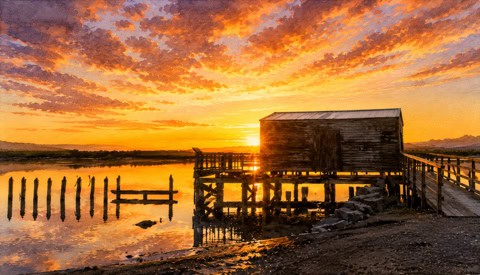
Hidden between ancient rainforest, a vast tidal lagoon and the wild Tasman Sea, Ōkārito feels like New Zealand from another era. Home to fewer than 40 permanent residents, this tiny West Coast settlement rewards those willing to pause, breathe deeply and appreciate a slower pace of life.
While thousands of travellers hurry between Franz Josef and Hokitika, those who take the short detour into Ōkārito discover one of the country’s most tranquil and rewarding destinations. Launch a kayak onto the mirror-like lagoon, climb the Trig Walk for sweeping coastal views, stroll the empty beach at sunset or simply sit on the wharf and listen to birdsong carried on the sea breeze.
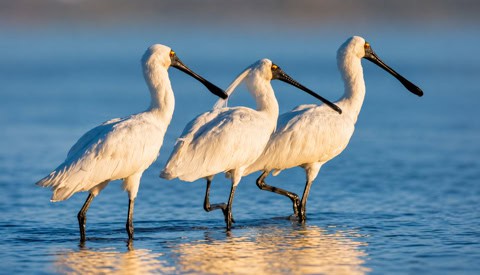
The lagoon itself is the largest unmodified wetland in New Zealand and provides a sanctuary for an extraordinary variety of birdlife. It is also the last natural stronghold of the critically endangered Rowi kiwi, making this small village an important conservation success story. Although seeing a Rowi in the wild is exceptionally rare, simply knowing they survive here adds another layer of magic to the experience.
Perhaps that’s what makes Ōkārito so special. There is no queue, no timetable and no pressure to tick off attractions. Instead, visitors discover the simple pleasure of being present in a place where nature still sets the rhythm of daily life.
Why It’s One of New Zealand’s Best-Kept Secrets
- One of New Zealand’s smallest and most peaceful settlements.
- Home to the country’s largest unmodified wetland lagoon.
- The last natural stronghold of the rare Rowi kiwi.
- Spectacular views from the Ōkārito Trig Walk.
- Exceptional kayaking and birdwatching opportunities.
- Wild beaches that are often completely empty.
George’s Tip
Stay until late afternoon if you can. Climb the Trig Walk when the light softens, then head down to the beach or wharf to watch the sun set over the Tasman Sea. Many visitors arrive for an hour and leave wishing they had stayed overnight.
Getting There
Ōkārito is located approximately 25 kilometres north of Franz Josef Glacier. Turn west from State Highway 6 onto Ōkārito Road and follow the sealed road to the village. Allow at least half a day to experience the lagoon, Trig Walk and beach, although an overnight stay provides a much richer appreciation of this unique place.
📍 GPS Coordinates: 43.216° S, 170.163° E
Wairaurahiri Wilderness & Waitutu Lodge – One of New Zealand's Ultimate Wilderness Escapes
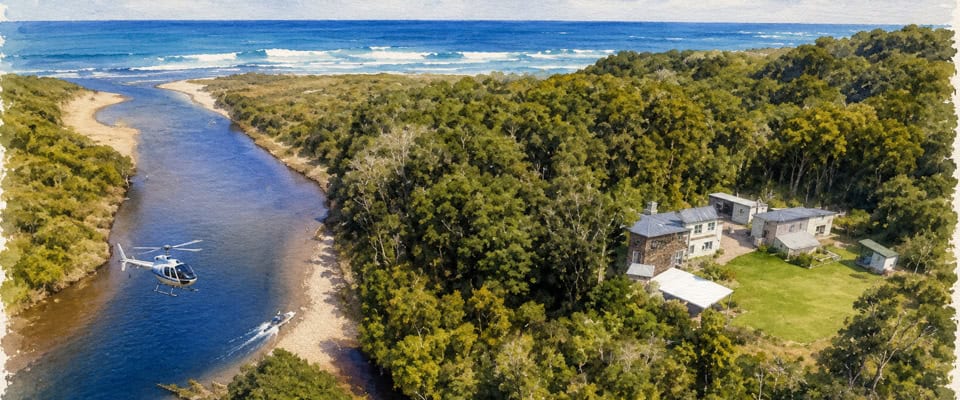
Hidden on Fiordland’s remote South Coast, the Wairaurahiri River and Waitutu Lodge offer one of New Zealand’s most extraordinary wilderness adventures. Reaching this isolated corner of the country is part of the experience itself, with visitors crossing Lake Hauroko before jet boating down the powerful Wairaurahiri River or arriving by helicopter above vast tracts of untouched forest.
Far from roads, towns and mobile coverage, Waitutu Lodge sits beside the southern edge of Fiordland National Park, surrounded by native bush and some of the most remote landscapes in New Zealand. For many visitors, it feels like stepping back into a time when wilderness still dominated the land.
The Story
The Wairaurahiri River drains Lake Hauroko, New Zealand’s deepest lake, before winding through rugged rainforest and remote valleys towards the South Coast. The river journey itself is unforgettable, with powerful rapids, towering forest and spectacular scenery creating one of the country’s most unique jet boat experiences.
At the end of the journey lies Waitutu Lodge, a comfortable wilderness retreat accessible by foot, helicopter or jet boat. The lodge serves as a gateway to the Waitutu Forest and the South Coast Track, where ancient podocarp forests and abundant birdlife provide a glimpse of New Zealand as it once was. Waitutu Lodge information
Why It’s One of New Zealand’s Best-Kept Secrets
- One of New Zealand’s most remote lodge experiences.
- Access by jet boat, helicopter or multi-day walk.
- Journey across Lake Hauroko and down the Wairaurahiri River.
- Situated beside Fiordland National Park.
- Ancient rainforest and untouched wilderness.
- A true off-grid South Island adventure.
George’s Tip
If you’re making the effort to reach Waitutu, stay overnight. The wilderness experience doesn’t begin and end with the jet boat ride. Spending a night surrounded by native forest, far from roads and modern distractions, is what makes this place truly unforgettable.
Getting There
Waitutu Lodge is located on Fiordland’s remote South Coast near Tuatapere. Most visitors arrive via a combination of Lake Hauroko boat transfer and Wairaurahiri River jet boat, while others choose helicopter access or multi-day hiking routes through the Waitutu Forest and South Coast Track.
📍 GPS Coordinates: 46.158° S, 167.487° E
The Best Discoveries Are Often the Ones You Didn't Plan
New Zealand’s most memorable experiences aren’t always found on the busiest roads or in the pages of every travel guide. Sometimes the places that stay with you longest are the ones discovered after taking a scenic detour, following a local recommendation or simply venturing beyond the familiar tourist trail.
From a forgotten whaling station hidden among Northland’s coastal forests to a remote wilderness lodge on Fiordland’s South Coast, these remarkable places reveal a side of New Zealand many travellers never see. Some are steeped in history, others shaped by powerful natural forces, but all offer something increasingly rare in modern travel – the feeling of genuine discovery.
The next time you’re planning a New Zealand adventure, consider leaving room for the unexpected. You may find that the places you remember most are not the famous attractions on the itinerary, but the hidden corners that weren’t on the map at all.